
If you have done undergraduate or are in any postgraduate program, then you must have come across the term “annotated bibliography.”
Most academic programs require students to write an annotated bibliography as an assignment but it serves a bigger purpose during the writing of Masters or PhD theses or dissertations.
This guide breaks down exactly what an annotated bibliography is, why it matters more than most students realize, and how to write one — with a complete APA-style example you can model your own work on.
What is an Annotated Bibliography?
The term “annotated bibliography” is a combination of two words: “annotated” and “bibliography”.
All students are familiar with a bibliography. It is simply an alphabetical listing of all sources that have been referred to and cited in any written piece of work.
A bibliography appears at the very end of each paper.
A bibliography can also be called a reference list or works cited though there is a slight difference.
A reference list or works cited is a listing of those sources that have been cited in a paper only and excludes sources that have been referred to but not directly cited in the paper. A bibliography on the other hand includes both the sources that have been cited and those that have been referred to but not directly cited.
A bibliography includes the metadata of the sources referenced including: the names of the authors, the year the source was published, the title of the source, the volume and issue number of the source, the place of publication, the name of the publisher, and the digital object identifier number. The metadata depend on the type of source used, that is, whether it was a journal paper, a book, a newsletter, a webpage etc.
The term “annotation” simply means a note or a comment about something.
Annotated bibliography therefore means notes/comments about a document.
An annotated bibliography therefore has two parts:
- The citation which appears first, formatted in whatever style your department requires (APA, MLA, Harvard, Chicago etc)
- The annotation – a short paragraph underneath the citation that unpacks what the source is, how credible it is, and how it connects to your research.
The Real Purpose of an Annotated Bibliography
The annotated bibliography serves various purposes:
- It is a listing of all the sources referenced and referred to when writing a paper. The annotated bibliography is mined later when the student is writing his thesis/dissertation.
- It makes writing a thesis/dissertation easier as it is the first step in the writing process. The annotated bibliography is usually prepared when reviewing literature.
- It enhances the critical thinking and analytical skills of a student. This is because part of the annotation is the relevance of the source to a student’s research. The student must therefore critically analyse how each source in the bibliography will shape or inform his/her research.
- It sharpens a student’s writing skills. When writing the annotation of the bibliography, the student is required to use his/her own words to avoid plagiarism. The more the student writes, the better he/she becomes at academic writing.
Related post: Academic Referencing 101 (The What, Why and How)
The Three Parts of a Strong Annotation
A solid annotation contains three main elements, in this order:
- A summary on what the source was about including, what was the purpose of the publication? what were the main findings?
- An evaluation of the source: was the source credible and reliable (for instance, was it peer-reviewed or not? Is it an industry publication or academic publication? How do the findings compare with the findings from other related resources (do they support their findings or not)?
- The relevance of the source to the student’s own research: do the findings support the student’s argument or not? Are there quotes, statistics, facts or examples that the student can borrow from the source that are relevant to their own research?
Not every annotation needs equal weight on all three. A source that’s central to your theoretical framework might get a longer, more critical treatment. A source you’re using for one statistic might get a shorter entry. Use your judgment.
How Long Should an Annotation Be?
There’s no universal rule — it depends on the purpose. If the annotated bibliography is a standalone class assignment, your instructor may only want the summary, which keeps entries short (roughly 100–150 words). If it’s feeding directly into your thesis or dissertation literature review, you’ll typically want all three elements — summary, evaluation, and relevance — which usually runs 150–250 words per source.
When in doubt, check your assignment brief or ask your supervisor directly what level of depth they expect.
Formatting Rules to Keep in Mind
- Arrange entries alphabetically by author surname, exactly as you would a standard reference list.
- Use the citation style your program requires — APA, MLA, Harvard, and Chicago each format the citation line differently, so don’t assume APA is the default.
- Keep the annotation as a single indented paragraph directly beneath its citation (most style guides use a hanging indent for the citation itself, with the annotation flush beneath it).
- Write annotations in your own words. Lifting sentences from the abstract defeats the purpose and risks plagiarism.
Sample of APA-style Annotated Bibliography
The following is an example of how to write an annotated bibliography using APA referencing style.
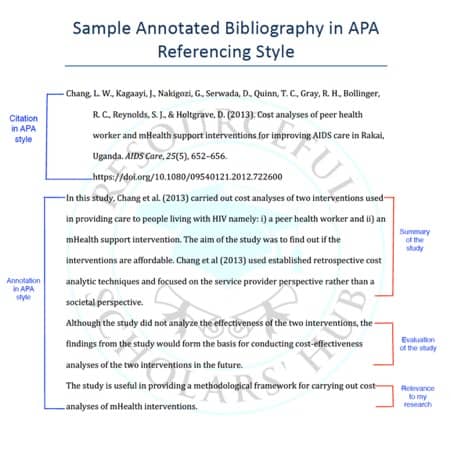
Notice how the annotation doesn’t just restate the abstract — it evaluates the method, flags a limitation, and explicitly ties the source back to the student’s own research. That last sentence is often the one students skip, and it’s the one that matters most for your literature review later.
Want a shortcut? Grab the free Annotated Bibliography Starter Kit — a fill-in-the-blank template, a worked example, and a citation-style cheat sheet, so you can start your bibliography today instead of staring at a blank page.
Common Mistakes to Avoid
- Summarizing without evaluating. A list of “this study found X” entries with no critical commentary isn’t an annotated bibliography — it’s a summary list.
- Forgetting the relevance link. Always end by connecting the source back to your own research question.
- Copying language from the abstract. Paraphrase in your own words; this is an academic writing exercise, not a copy-paste task.
- Skipping the alphabetization or citation formatting. Small formatting errors are an easy, avoidable way to lose marks or credibility with your committee.
- Writing it once and never returning to it. Treat your annotated bibliography as a living document you update as you read more sources — it will save you hours when you sit down to write your literature review chapter.
Final Thoughts
Writing an annotated bibliography is not difficult but it requires two skills that take practice: condensing a source into a few honest sentences, and thinking critically about how it fits into the bigger picture of your research. Most postgraduate programs don’t formally require one, but doing this work anyway — even informally, as you read — will make your literature review chapter significantly easier to write.
If you’re currently working on your PhD or Masters thesis proposal and want a structured way to organize not just your annotated bibliography but your entire Chapter 1–3 writing process, take a look at the PhD Thesis Proposal Toolkit — it includes a full writing guide, an editable Word template, and a checklist to make sure nothing gets missed before submission.
Related posts:
Academic Referencing 101 (The What, Why and How)
How To Use Zotero For Reference Management (An Illustrative Guide)
How To Use Mendeley For Reference Management (An Illustrative Guide)