
Introduction
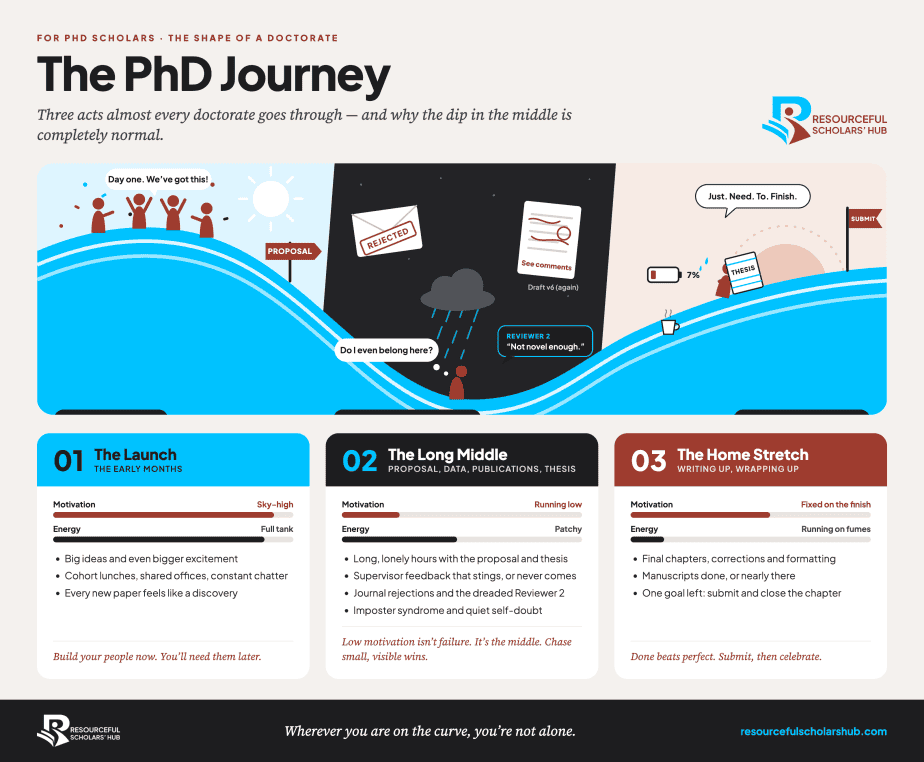
A PhD is a marathon, not a sprint. Some weeks the words flow and the finish line feels close. Other weeks you open your laptop, stare at the same paragraph, and wonder why you signed up for this at all. If you’ve had moments of self-doubt, or even thought about quitting, you’re not alone. Almost every PhD student hits these walls somewhere between coursework and the final defence.
So how do you survive a PhD and actually finish it? There is no single formula, but some habits make the road much easier. In this article, I share five lessons from my own PhD journey and from classmates who have walked it with me. They include knowing your “why,” choosing a topic you love, finding an accountability partner, taking breaks without guilt, and planning ahead.
Know your “Why”: That will keep you going
We all have reasons as to why we started our PhDs.
For some, it is for career progression or advancement. For others, it is the thrill of adding another academic certificate on their shelves.
For some, it is for self-actualisation, having had a number of career and personal accomplishments in their name.
Yet for others, it is just for the sheer joy of reading and writing.
There is no wrong reason for starting a PhD.
However, your reason for starting a PhD should be strong enough to see you through your PhD journey.
Knowing your “why” is a good motivation to keep you going even when the PhD journey is long and winding, with no clear sight of the finish line.
Choose a research topic you’re passionate about
When choosing a research topic for your PhD, passion should be one of the guiding principles.
Passion for your topic will keep you awake at night, in a good way.
Passion for your topic will make you open that laptop when you don’t feel like it.
Truth be told, during your PhD journey, you will have moments when you are highly motivated. You will also experience moments when you don’t feel like doing anything regarding your PhD. It is this passion that will propel you forward.
Find a PhD accountability partner
The PhD journey can be one lonely journey.
For those doing coursework + thesis program, the coursework stage is often exciting because you get to interact with your classmates and different faculty staff on a regular basis. This often changes as soon as you get to the proposal and thesis writing stage. Then it’s just you, your supervisors, and your God.
It is so easy to become disillusioned and lose interest when you are all alone with your thesis. Most times, your supervisors hardly engage unless there’s a good reason to.
This is when an accountability partner can come in and help make the journey bearable. An accountability partner can be anyone, either someone who has gone through the journey before, or even a classmate, or a friend or family.
When choosing an accountability partner, be mindful to choose one with your best interest at heart.
In my case, my accountability partner is a classmate in the same program. We check on each other’s progress on a regular basis, give each other the push and motivation we both need, and share experiences and insights on how to navigate the challenges we face. Additionally, we celebrate each other’s small wins.
This is important in having an all-rounded approach to the PhD journey. It should not always be about the challenges and hard times, but also the good times and the wins.
It is OK to take a break: Protect your mental health
Ever seen a marathon runner stopping to drink water? This is a common scene in any marathon.
The same should apply to PhD studies.
When you are struggling with writers’ block, stop and take a break.
When you feel physically fatigued and disinterested in your PhD work, take a break.
Going through a family situation? Or a relationship crisis? By all means, stop and take a break.
Just delivered a baby in the course of your PhD program? Just take a couple of months’ rest to nurture yourself and your newborn. It is OK.
It is OK to take a break when life demands of it.
After all, PhD students are human beings first, and just because you are doing your PhD does not mean that other aspects of your life will come to a standstill. No, things will happen that will interfere with your mental and physical ability to proceed with your studies.
The break you take can last for a short while or it can even take months or years, depending on the situation.
I recall a classmate who suddenly lost her mom and it affected her mental and emotional ability to handle the stress of a PhD. So she took an academic leave of absence for two years so as to grieve her mom and heal.
Another got a baby, and couldn’t handle the demands of a newborn baby while still working on her PhD. So she took a year off her PhD program and resumed when her baby was more independent.
Another lost her job and had to pause her PhD studies for several months to sort her financial situation. The stress of losing her source of livelihood was too much to handle.
Taking a break is necessary for rejuvenating one’s physical, mental and emotional well-being, which are key ingredients in succeeding in a PhD program.
Plan ahead: Break your PhD into yearly, quarterly, monthly and weekly goals
There’s a common saying that “failing to plan is planning to fail.”
A PhD program has a specific timeframe, which varies from one institution to another, and from one program to another.
It also has several requirements, which also vary from one program to another. These include: coursework, a thesis, at least 2 journal papers, a conference paper published in a conference journal/book, a case study etc.
In order to complete a PhD program in time, it is important for students to plan their time well, with the PhD requirements in mind.
In my case, I develop annual plans at the beginning of each year. Then from the annual plans, I create semi-annual plans, quarterly plans, monthly plans, and lastly weekly plans.
As an example, in 2025, I planned to write and submit 3 papers to journals for publication, and also finalise my thesis. So I further broke down this annual plan into semi-annual plans. For the first six months, my plan was to write and submit the first two journal papers, then for the second six months, my plan was to write and submit my third journal paper and complete the first draft of my thesis.
The semi-annual plans were further broken down into quarterly plans. Quarter 1 – first journal paper, quarter 2 – second journal paper, quarter 3 – third journal paper, quarter 4 – submit first draft of my thesis.
The quarterly plans were further broken down into monthly and weekly plans. These included: searching for references, reviewing literature, writing different sections of journal papers, submitting the draft manuscripts to supervisors for review and comments, addressing supervisors’ comments, submitting manuscripts to journals, learning an analytical technique, reference management, proofreading thesis, formatting thesis etc.
The plans have helped me immensely to stay on track and achieve my milestones because at each given point in time I am laser-focused at one particular activity. Hence I am able to look back at my Gantt chart and tick off completed activities.
Put these tips into practice with my free PhD Planner 2027. Plan your month, choose your top three priorities each week, and track your progress. Get it free here.
In addition to creating plans, it is also important to take stock of what you have been able to accomplish at the end of each week, and what activities have not been done and therefore need to be pushed forward to the following week. In my case, I do the stock taking at the end of each week as I plan for the following week’s activities. I also try to minimise having backlogs as much as humanely possible.
However, once in a while, I will experience a situation or crisis, for instance, a child will fall sick and be hospitalised or work will be too overwhelming which will reduce the time I have for my PhD studies.
During such moments, I extend myself some grace, and do the bare minimum, while planning to make up for the pending work as soon as I am able to. What I have experienced though is that as long as I stay committed to my plans, such crises or situations do not interfere too much with my ability to accomplish my goals. They are simply hiccups in my PhD journey.
Final thoughts
Surviving a PhD isn’t about being the smartest person in your cohort or working through every weekend. It’s about staying in the race long enough to cross the finish line. For me, five things have made the biggest difference. I remember why I started, I keep my passion for my topic alive, I lean on my accountability partner, I pause when life demands it, and I work from a clear plan. On the hard days, these habits have kept me moving, even when the progress was small.
Your journey will look different from mine, and that’s fine. Take what works, adapt it, and give yourself grace when things don’t go to plan.
What has helped you keep going in your PhD? Share your tips in the comments. Another scholar might need them today.
For more practical PhD guides, subscribe to our newsletter.
Make 2027 your most productive PhD year yet
Progress on a PhD rarely comes from one big push. It comes from ordinary weeks that are well planned. That’s why I created My PhD Planner 2027, a free planner with 130 pages you can type into or print. It includes monthly and weekly plans, quarterly goals, a thesis milestone roadmap, a supervisor meeting log, a literature tracker and a writing tracker.